Ethan Levitas
Ethan Levitas


Over the past ten years, the United States and indeed much of the world, has struggled to find a balance between authoritarianism and liberty, security and freedom of expression. A significant but often invisible casualty in this conflict is the photographer working in public space, the photographs s/he creates, and by consequence, the ways in which citizens and societies come to see, question and know themselves. Nowhere is this fact more striking than in the hyper-surveilled streets of New York City - a city crucial to the development of the medium of photography - where police have arrogated to themselves the authority to censor, harass and detain photographers in the name of law, order and national security.Read more
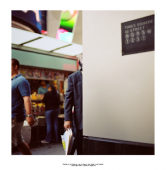
In this context Ethan Levitas has directed his camera on the police themselves; the result is the work In Advance of a Broken Arm.
Made throughout New York City and in compliance with all laws governing public photography, In Advance of a Broken Arm is a series of photographs of confrontations that are initiated by the presence of the camera itself. Fusing diverse photographic practices - improvised street photography, relational process and self-portraiture, and the Document - Levitas’s work is a chronicle of engagement, observation, and consequences that not only interrogates the nature of threat and the exercise of power but also grounds the photographic practice in the act of civic participation.
The subject of In Advance of a Broken Arm is not simply the police, the subjects who are photographed. First and foremost, the critical moment of this work is what comes before: the act of the photography itself. For in this particular relation and context, the act, and the articulation of the act, the photograph, situate the Photographer’s Practice in Speech. And not just Speech, but Dissent. Which is to say the subject of In Advance of a Broken Arm is the assertion of a space and an action that are increasingly elusive, often perilously so, but fundamental to a functioning democracy. In short, these are not pictures of power; they are, in fact, the claim – and the reality – of the photograph as power itself.
Ultimately, In Advance of a Broken Arm presents and invites a meditation on the possibilities that inhere in the medium and the relationship between artist and society.