
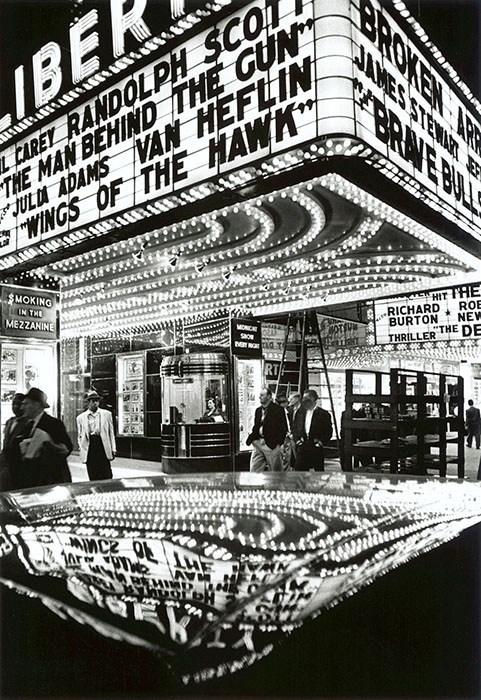
William Klein is celebrated for his large photographic frescoes depicting New York, Rome, Moscow, Tokyo and Paris. However, his openly critical and political body of work remains relatively unknown. To mark the centenary of his birth, the exhibition This Way to Heaven showcases the artist’s commitment, combining photographs, paintings, films and drawings, and reveals many previously unseen documents. In a corpus that is as caustic as it is visionary, William Klein portrays the visual spectacle provided by the mass media and the power systems they perpetuate. The artist methodically dismantles the well-oiled mechanics of the image as formatted by the press and then nascent television, rearranging them in a deliberately corrosive way.
For this American who settled in Paris immediately after the war, what better place to observe the emerging society of the spectacle than the entertainment epicenter of the world? He thus returned to the United States in 1954 to produce his first major photographic opus: an uncompromising portrait of his native city, capturing the cult of the dollar and the consumerist injunction while mimicking the sensationalism of the tabloid press. Furthermore, three of his greatest films were made in the 1960s with three real or fictional American characters, Muhammad Ali, Polly Maggoo and Mister Freedom. Each of these figures embodies in its own way—whether combative, candid or brutal—a polarised society, bruised by the continual spectacularization of public, private and political life.
From the light of his early photograms, through the neon lights flooding the New York night with advertising messages, to the spotlights shining on icons such as Ali and Polly, this exhibition traces the trajectory of an artist who, like a family member refusing to surrender, tirelessly reminded his country of its broken promises, turning the mirror around to show it its true face.
Raphaëlle Stopin


